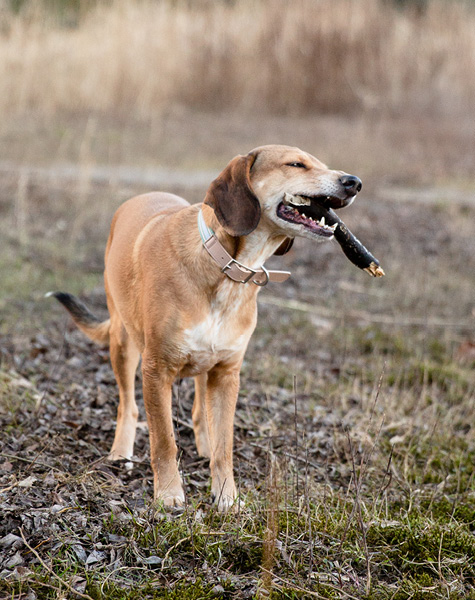
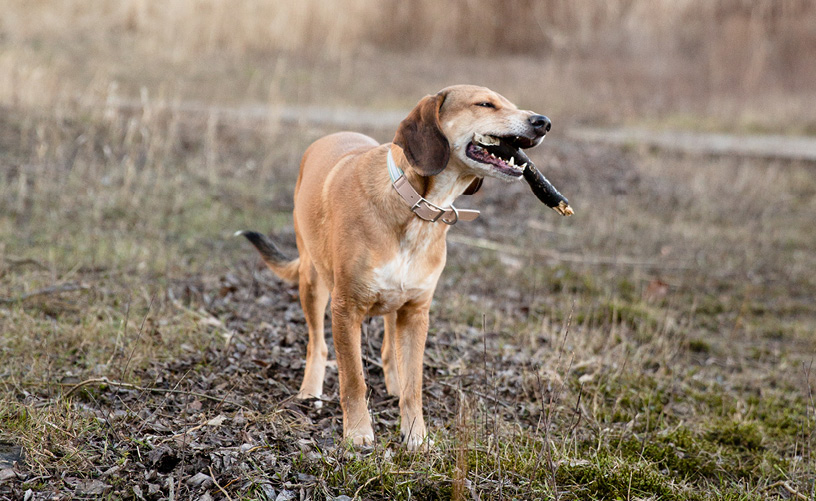
Your dog needs more than physical exercise. Their mind needs stimulation, too. Mental stimulation for dogs means actively challenging their thinking skills so they feel good both physically and mentally. In this article, you’ll learn why this matters and how to easily stimulate your dog indoors, even on cold, rainy days.
This article is for dog owners who want to give their pet a happier and more balanced life. You do not need a training room or a big budget. You will learn which games work well, how to turn everyday kitchen items into toys, and why rest is just as important as activity.
What is mental stimulation for dogs?
Mental stimulation for dogs means giving them activities that engage their problem-solving skills. Think of scent games, food puzzles, search activities and learning new commands. The aim is to keep their mind active, not just their paws.
Dogs are naturally curious. They have evolved to search, sniff and solve problems. When these needs are not met, unwanted behaviour can develop. Mental stimulation is therefore not a luxury for your dog. It is an essential part of responsible pet care.
Why mental challenges are essential
Behavioural research shows that interactive games can help prevent behavioural problems in dogs. Dogs that get enough mental stimulation are calmer, experience less stress, and show fewer signs of anxiety. Mental stimulation can also slow cognitive decline in older dogs, much like brain games do for people.
Destructive behaviour: when boredom takes over
Destructive behaviour, such as chewing furniture, digging into cushions or barking constantly, is often not a sign of disobedience. It is usually a sign of boredom. Dogs that don’t get enough mental stimulation will find their own outlet, and it is rarely something you will be happy about.
How can you tell if your dog is destructive due to a lack of stimulation?
Not all destructive behaviour has the same cause, but some patterns are clear. If your dog is particularly restless when you are away, constantly chases toys or frequently licks their paws, it can indicate an underlying issue. Mental challenges help reduce stress and anxiety in dogs, which can also prevent many forms of unwanted behaviour.
Food puzzles: stimulation at mealtimes
One of the easiest ways to keep dogs mentally active is through their food. Food puzzles encourage dogs to solve problems and think about how to reach their kibble. It may sound simple, but it requires genuine effort and uses a lot of your dog’s energy.
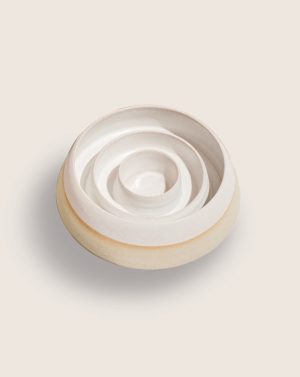
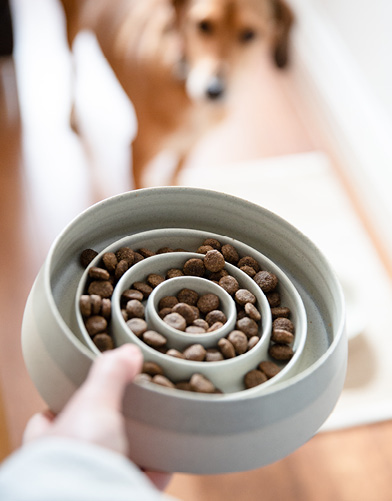
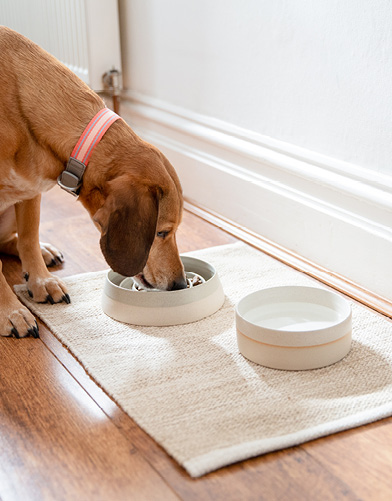
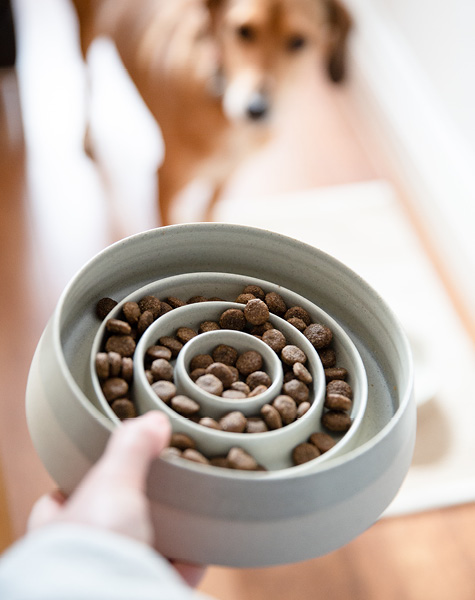
The Pawness slow feeder bowl: challenge and craftsmanship in one
The Pawness slow feeder looks beautiful and works effectively. The clever rings inside the bowl encourage your dog to eat more slowly. Your four-legged friend has to make more effort to reach their food, which is especially helpful if your dog tends to eat too quickly. Every slow feeder bowl is handmade from natural clay and designed and crafted in the Netherlands, making each piece unique.
Besides providing a mental challenge, the slow feeder bowl supports healthy digestion and reduces the risk of choking. Use it for your dog’s daily meals to create a regular moment of mental stimulation.
Available in medium and large. Choose from emerald, grey and white. Pair it with a Pawness food bowl to use as a water bowl. Order two or more and receive an automatic 20% discount.
Scent games: put your dog’s nose to work
A dog’s sense of smell is estimated to be 10,000 times more sensitive than a human’s. Sniffing is not a passive experience for dogs. It is an active exercise that can tire them mentally, even when they barely move. This makes scent games one of the most effective ways to keep your dog mentally stimulated indoors.
Homemade treat dispensers using toilet rolls
Dog owners can create fun scent and search games at home. Homemade treat dispensers are easy to make using toilet rolls. Fold the ends closed, place a few treats inside and give the roll to your dog. They will need to work out how to reach their reward, which requires more mental energy than you might expect. Remember that treats should make up no more than 10% of your dog’s daily calorie intake.
Scent games with empty containers
For this scent game, use empty containers to hide treats. Place three containers upside down on the floor. Hide a treat under one of them and let your four-legged friend search for it. This game trains their sense of smell, improves concentration and provides a rewarding challenge. You don’t need to go outside.
Interactive play with everyday materials
You do not need to buy expensive toys to keep your dog mentally stimulated. Almost every home already has everything you need for a fun, challenging activity together. Variety matters more than the price of the materials you use.
Muffin tins and balls as a simple puzzle
Use a muffin tin and balls to create an interactive game for your dog. Place a treat in each compartment and cover it with a tennis ball. Your four-legged friend must move each ball aside to find the reward. This simple food puzzle is for any dog, regardless of age or experience.
Teaching new tricks as a mental activity
Learning new commands stimulates your dog’s mind. It requires concentration, memory and pattern recognition. Choose a quiet moment and keep each session short, between five and ten minutes. Gradually increase the difficulty. Dogs are mentally active whenever they learn something new.
Hidden tasks and indoor search games
Hide a toy or treat in another room. Ask your four-legged friend to find it using a command such as “search”. Start nearby so your dog can succeed quickly, then gradually make the activity more difficult. This simple activity engages both their sense of smell and their ability to learn, with minimal preparation.
Mental stimulation for older dogs
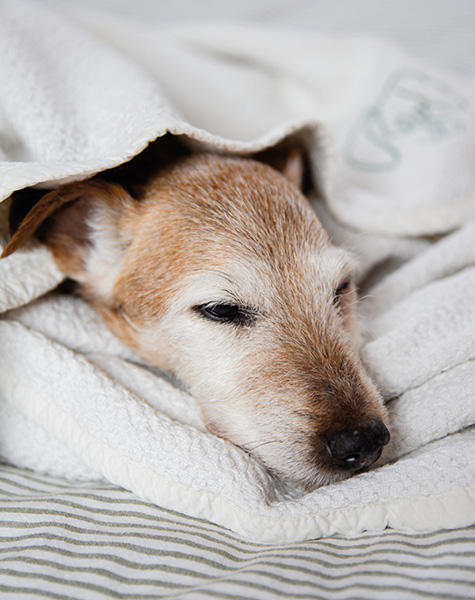
Mental stimulation can help slow cognitive decline in older dogs. This does not mean that you should give senior dogs demanding tasks. Gentle and regular challenges are a better choice. Keep sessions shorter, offer simpler tasks and provide some variety each day. This helps keep their brain active as they age.
An older dog that has received little mental stimulation earlier in life can still start at any time. Begin slowly with scent games and adapt the difficulty to their pace. Mental stimulation works best when it suits your dog’s stage of life. Do not treat it as a programme in which they need to perform or achieve.
A calming atmosphere as the foundation for mental wellbeing
Mental stimulation works best when dogs feel safe and relaxed in their environment. A pleasant atmosphere at home helps them learn, sniff and play. This is especially important on grey, rainy days when staying indoors is the natural choice for you and your dog.
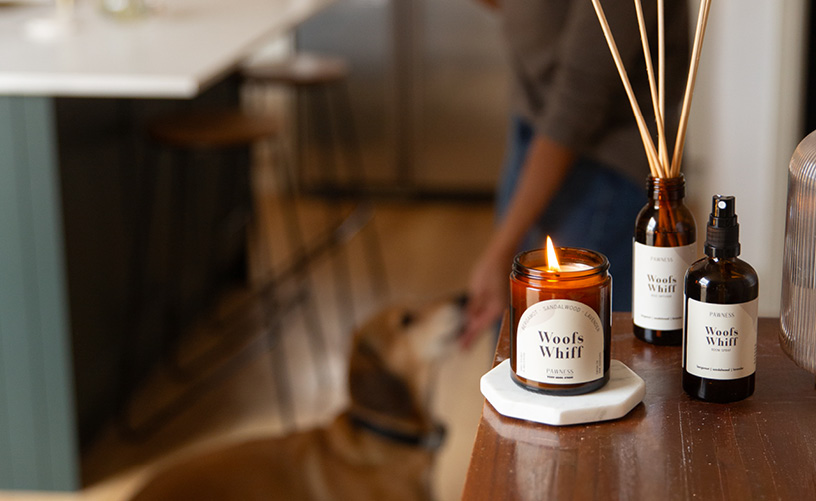
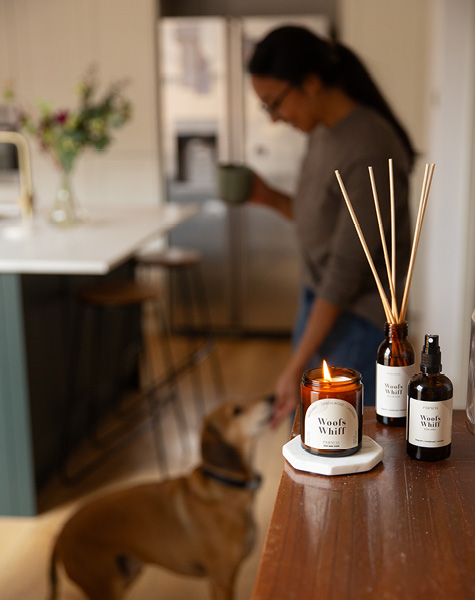
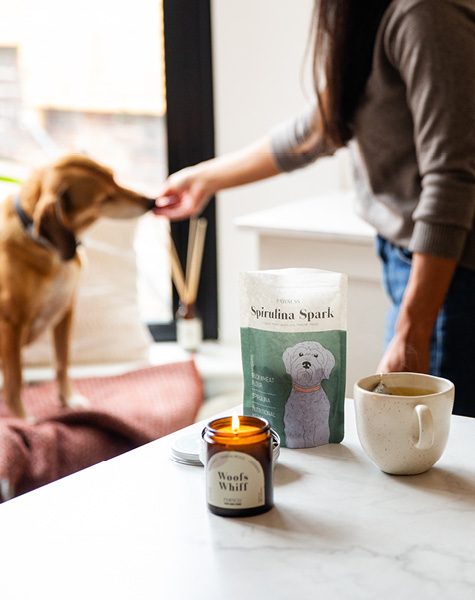
The Woofs Whiff collection: comfort for the whole pack
The Pawness Woofs Whiff collection was created for exactly these moments. The collection includes a scented candle, reed diffuser, and a room spray. The fragrances have been carefully created to be pleasant for dogs. Bergamot adds a fresh note, sandalwood brings warmth, and lavender encourages relaxation. Together, they create a cosy atmosphere where you and your dog can unwind.
The candle is hand-poured using 100% natural rapeseed wax and comes in a recycled amber glass jar. The fragrance sticks last for four to six months without requiring any attention. The room spray instantly adds a fresh scent. On an ordinary afternoon, while the rain falls and your dog relaxes on the sofa, this atmosphere feels just right. The Woofs Whiff collection is part of the Pawness home collection, designed for homes thoughtfully made for people and dogs.
How often and for how long: guidelines for every stage of life
No single answer works for every dog. A useful guideline is one or two short sessions of five to fifteen minutes each day. Young and active dogs usually need more variety than older or calmer dogs. Look out for signs of tiredness or frustration. If your dog turns their head away or lies down, they have probably had enough.
Variety keeps stimulation fresh
Dogs quickly become familiar with the same activities. Alternate between scent games, food puzzles, learning sessions and calming activities. This variety keeps mental stimulation interesting and prevents your four-legged friend from losing interest. New challenges activate different parts of the brain than familiar routines.
Dog mental stimulation in practice: a simple daily routine
Mental stimulation does not need to be an extensive programme. Serve your dog’s meal in a slow feeder bowl. Play a scent game after your walk. End the evening in a calming atmosphere. This is an easy way to add mental stimulation to your dog’s daily routine. You may soon notice a difference in their behaviour and mood.
Conclusion: a mentally fit pet starts at home
A pet that receives enough mental stimulation is happier, calmer and healthier. Scent games, food puzzles, learning activities, and a warm atmosphere at home give dogs what they need, even on days when going outside isn’t an option. Small changes to your daily routine can make a big difference. Pawness supports you with thoughtfully made products that contribute to your pet’s wellbeing.
Sources:
Mentale uitdaging vermindert stress en angst bij honden
Association of Pet Behaviour Counsellors (APBC). “Help! My Dog is on Exercise Restriction.” APBC.org.uk. Geraadpleegd 2026. https://apbc.org.uk/help-my-dog-is-on-exercise-restriction/ — “In kennelled dogs, enrichment has been shown to decrease stress, anxiety, and fear-induced aggression.”
RSPCA Australia. “Pet Enrichment for Dogs and Cats.” Vetcross.com.au. Geraadpleegd 2026. https://www.vetcross.com.au/blog/pet-enrichment-dogs-cats
Cognitieve achteruitgang bij oudere honden
Landsberg, G. “Brain aging in dogs: Prevention and treatment.” DVM360, deel 2 van een tweedelige serie. Geraadpleegd 2026. https://www.dvm360.com/view/brain-aging-dogs-prevention-and-treatment-second-two-part-series
Owczarczak-Garstecka, S.C. & Burman, O.H.P. “Do dog owners recognise behavioural indicators of canine cognitive dysfunction and can environmental techniques slow its progression?” ResearchGate, 2016. https://www.researchgate.net/publication/343539482_Do_dog_owners_recognise_behavioural_indicators_of_canine_cognitive_dysfunction_and_can_environmental_techniques_slow_its_progression
Reukzin van honden
Horowitz, Alexandra. Inside of a Dog: What Dogs See, Smell, and Know. Scribner, 2009. — Beschrijft dat het reukorgaan van honden naar schatting tienduizend tot honderdduizend keer gevoeliger is dan dat van mensen.
Traktaties en dagelijkse calorie-inname
Tufts University Cummings School of Veterinary Medicine. “Kibble Confusion.” Tufts Now, 14 maart 2011. https://now.tufts.edu/2011/03/14/kibble-confusion — “A general rule is that owners should aim for treats to comprise 10 percent or less of a pet’s daily caloric intake.”
I’m Denise, the founder of Pawness. The company was born out of my love for my dog, Bo, and my search for fair, beautiful products for dogs. I believe that every choice matters: for your dog, for the planet, and for the people behind the products. Through these blogs, I help puppy parents make more conscious choices—without making it complicated.