
Barking – every dog does it. Some just do it a bit more than others. Although barking is a completely natural behaviour for dogs, people can quickly find it annoying. Fortunately, it’s very possible to reduce excessive barking. As with all behaviour, the earlier you address it, the easier it is to change. That said, even adult dogs who have been barking excessively for years can still learn new habits.
Why do dogs bark?
Barking is one of the sounds dogs make to express themselves. It’s always a form of communication. Dogs bark for many different reasons. Each reason requires its own approach to ensure your training is successful, so it’s crucial to understand why your dog is barking in the first place.
In general, we distinguish six types of barking: the joy/excitement bark, the warning bark, the fear bark, the guarding bark, the frustration bark, and the learned bark.


The joy bark
The joy bark is the high‑pitched, expectant bark dogs use when they are happy and excited. You might hear this bark when you come home, when you’re playing together, or when your dog realises something fun is about to happen. Because of its high pitch, this almost hysterical bark can quickly become irritating. Your dog is full of adrenaline and will move a lot (spinning in circles, jumping up and down). Sometimes the sound turns into a kind of whine.
The warning bark
Ideally, you’ll hear the warning bark much less often. Dogs use this bark to alert other dogs or people to something they might have missed. In principle, a warning bark is a single bark, but when it becomes a learned behaviour, a dog can turn into a real “alarm barker”. A watchful bark is loud and can be especially annoying for neighbours. Over time, this can lead
The fear bark
The fear bark is a high‑pitched, almost hysterical bark your dog uses when experiencing intense stress. What counts as stressful differs from dog to dog. Some dogs are afraid of unfamiliar, unmoving objects; others of unfamiliar people. The bark is high, and the frequency is higher than with the joy bark. Dogs may also try to hide or run away.
The guarding bark
The guarding bark is the bark dogs use to defend something they consider theirs. Because this bark often alternates with growling and baring teeth, dogs showing this behaviour are often – and unfairly – labelled aggressive. In reality, a dog that uses this kind of warning bark is usually insecure and afraid


The frustration bark
The frustration bark is the monotone bark dogs produce when they are frustrated. You often hear this type of bark when you walk past kennels. Dogs that are chained up may also bark like this. A frustration bark is a sign of stress and loneliness and is often almost continuous. Usually, there is a short pause after a series of barks, and then it starts again. This often goes hand in hand with stereotypical behaviours such as digging, over‑grooming (even to the point of licking themselves sore), and tail chasing.
When is excessive barking a problem?
Barking is natural behaviour and almost always has a purpose. A dog won’t bark just because they feel like it. The problem arises when a dog barks so much that it causes frustration and conflict.
We talk about excessive barking when a dog barks more often or more loudly than necessary to express itself naturally. This is often linked to learned behaviour and/or frustration. For example, a dog will continue barking if that behaviour has been rewarded in the past. Likewise, when no one responds to a warning bark, the dog may bark even more. The dog learns that barking “works” in certain situations.
Teaching your puppy not to bark: preventive tips
When raising your puppy, you mustn’t let them learn that barking is rewarding. So don’t reward barking – but don’t get angry either. The best thing you can do is expose your puppy to as many different situations as possible: visit a petting zoo, train station, or busy shopping street. The more your dog sees, the less likely your puppy is to start barking at new things.

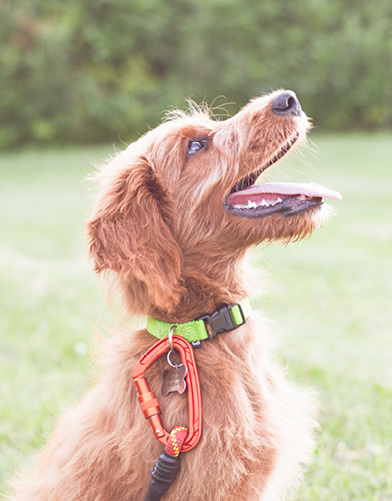

Puppies often bark with excitement when they want to greet someone. You don’t want to reward this unwanted behaviour. To teach your puppy not to bark for attention, make sure they only get what they want once they are quiet. For example, teach your pup that they can greet people or other dogs only after they sit calmly.
Teaching your dog not to bark in 6 steps
Although the exact method for reducing excessive barking depends on the cause, we’ve put together a general step‑by‑step plan. You can use it for both puppies and adult dogs.
Stap 1. Don’t get angry
Barking is natural behaviour and is never meant to annoy you. Teaching a dog not to bark is not the same as punishing barking. Punishing barking usually makes things worse and doesn’t help you reach your goal. Your dog can become insecure or frustrated. On top of that, “no” is a vague cue. It’s much more helpful to show your dog what you do want them to do.
Step 2. Identify why your dog is barking
As mentioned earlier, each type of barking needs its own approach. The high, almost hysterical joy/excitement bark is linked to high arousal and calls for a different strategy than the low, fearful bark. While we’ve already described the different types of barking, it’s important to recognise them in your own dog.
Joy bark:
Your dog is full of adrenaline and moves a lot (spinning in circles, jumping up and down). The bark is high‑pitched, and the barks follow each other in quick succession, creating a hysterical, sometimes whiny sound.
Warning bark:
In principle, this is a single, loud, low bark to get your attention. It can develop into a persistent guard bark if your dog has learned that you don’t respond to that first warning. Over time, this can turn into obsessive barking whenever someone or something passes by.
Fear bark:
Your dog is highly stressed and restless or agitated. They may try to hide or run away. The bark is high and always comes in series. Although it can sound similar to the joy bark, it has a higher frequency. You can often see from your dog’s posture and overall behaviour whether they are excited or afraid.
Guarding bark:
Your dog bares their teeth and growls between barks. They may perform a mock charge or, in the worst case, even snap or bite if the “opponent” doesn’t move away.
Frustration bark:
When a dog uses a frustration bark, they are stressed and bored. This type of barking often occurs together with stereotypical behaviours such as digging, over‑grooming (even to the point of licking themselves sore), and tail chasing. The bark is monotone and almost continuous. A series of barks is often briefly interrupted, then resumes.
Step 3. Gradually expose your dog to the situation
Once you’ve identified the cause of your dog’s excessive barking, you can start training. Gradually expose your dog to situations where they usually bark. By “gradually”, we mean that you don’t place your dog right in the middle of the situation, but start at a comfortable distance and build up slowly. A dog that is highly aroused or afraid simply can’t learn.

For example, if your pup barks at children, start by walking past a schoolyard on the opposite side of the street. When this goes well, gradually increase the time you spend near the school. Introducing your dog to a child directly is only the very last step.
Step 4. Ask for alternative behaviour
Think about what behaviour you do want to see from your dog in this situation. Often it’s easiest to choose a behaviour that’s incompatible with barking. Make sure you consider the cause of the barking. For dogs that bark out of excitement, asking them to sit may already be enough. For dogs that bark out of fear, distraction can help – ask them to fetch something for you, for example
For dogs that bark when the doorbell rings, it can help to teach them to go to their bed or designated spot. By asking for this alternative behaviour, you can actively work on reducing the barking
Step 5. Reward the behaviour you want
Does your dog show the behaviour you want instead of barking? Great! Time for lots of cuddles, treats, and attention. Every dog deserves recognition for each small step. Celebrate your dog even when they show the desired behaviour at a distance – for example, on the other side of the playground.


Step 6. Practise and stick with it
Teaching your dog not to bark takes a lot of training and repetition. Your dog won’t stop excessive barking in just one day. Dogs don’t automatically know what you want from them. Work towards your goal in small steps and reward your dog every time they do what you’re asking for. Dogs don’t think the way we do, so patience is essential.
Extra tips for teaching your dog not to bark
Reducing unwanted barking requires consistency. Make sure everyone in the household follows the same approach. Young dogs generally learn faster, but older dogs can absolutely learn new behaviours too.
If your dog uses barking to get attention, make sure they’re quiet before you respond. A situation where your dog barks at passers‑by, for example, needs a different approach than barking out of boredom.
Conclusion
With the right approach, it’s very possible to reduce excessive barking. Whether you’re working on a puppy or an adult dog, consistency and patience are key. Punishing barking doesn’t work – positive training does. With these steps, you can help your dog bark less and become a calmer member of the family.
Sources: “How to Stop Excessive Barking in 6 Steps & Extra Tips”
– Easy Peasy Puppy Squeezy, Steve Mann
–Blafgedrag van honden, Turid Rugaas

I’m Denise, the founder of Pawness. The company was born out of my love for my dog, Bo, and my search for fair, beautiful products for dogs. I believe that every choice matters: for your dog, for the planet, and for the people behind the products. Through these blogs, I help puppy parents make more conscious choices—without making it complicated.